Deploying Robotics for On-Site Construction

PREAPRED BY: ARCHER COMPTON
Director of Strategic Growth, Horizon Legacy
Summary
Canada faces a critical construction labour shortage: one in five workers will retire in the next decade. According to CMHC, this labour shortage threatens our ability to deliver 4.8M new homes needed in the next decade to restore affordability.
In the first proof-of-concept deployment of on-site robotics in a Canadian residential project, Horizon Legacy is proving that its VAL 2.0 robotic system can help close the gap—boosting efficiency, improving labour productivity, and unlocking new housing possibilities.
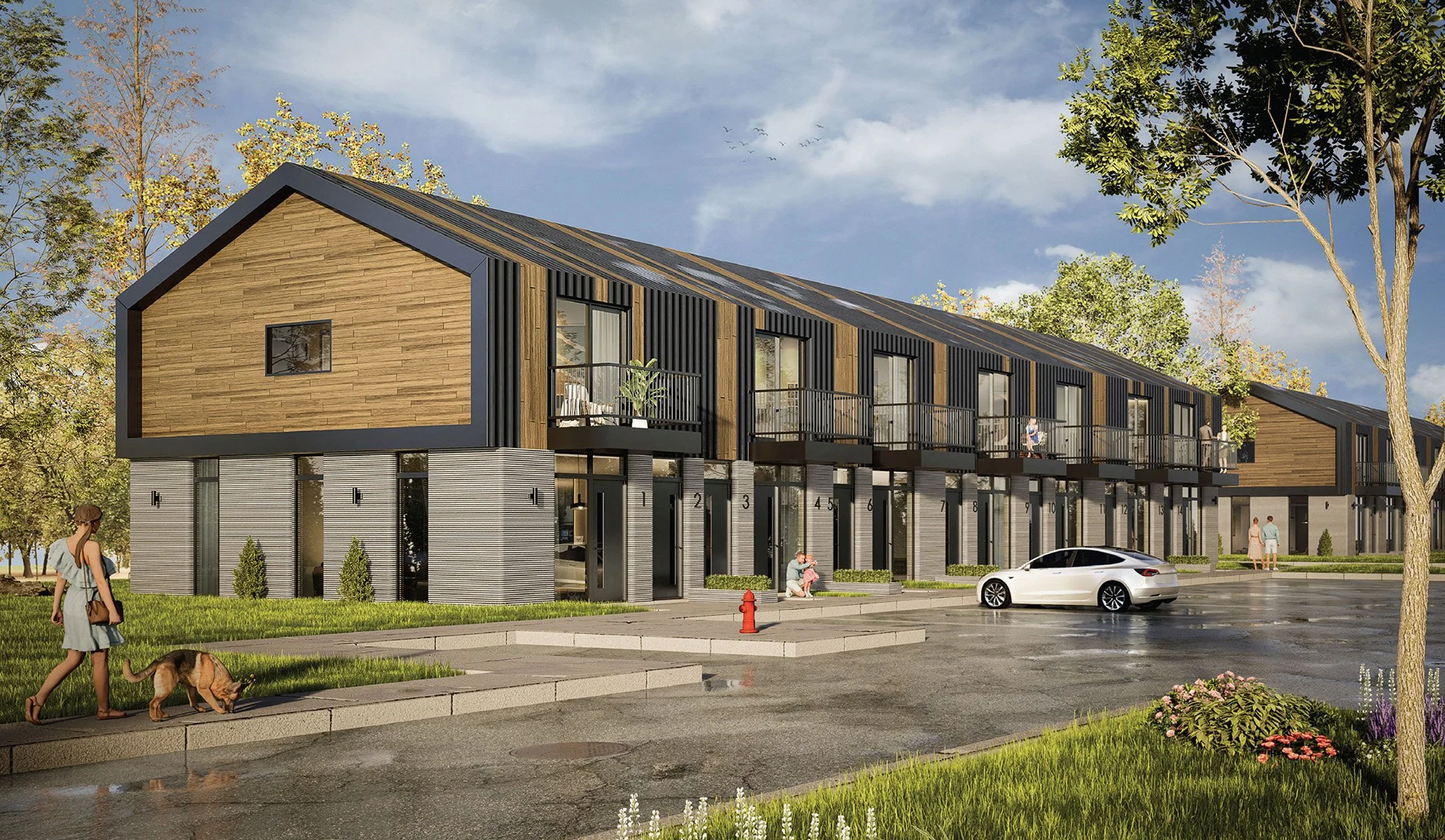
Project Overview
Developer: Horizon Legacy
Location: 425 Fourth Street, Gananoque, Ontario
Type: Multifamily (Townhouses)
Units: 26 units
Construction Method: Automated Construction
Completion: Fall 2025
Design and Construction Overview
The first-floor perimeter walls were built using on-site robotics, aided by a team of five, while the second storey was built with timber.
The robotic system, led by a 7-axis robot called VAL 2.0 and supported by a concrete pumping system, executed a complete wall assembly of concrete, serving both as self-supporting structures and building facades. Every wall was pre-programmed, allowing the robot to construct precisely according to the digital model.
Impact on Housing Delivery
Improved Labour Productivity: On-site robotics, aided by a team of five, completed the Gananoque walls on schedule with fewer personnel compared to traditional methods.
Cost Efficiency: Automation enables 8-foot windows, 9-foot ceilings, and other modern amenities while keeping average hard construction costs under $300,000 per unit.
Affordability: In the Gananoque project, 30% of units are designated as affordable rentals. On-site automation is driving faster delivery of much-needed affordable housing
Sustainability & Lifecycle Analysis: The buildings are all-electric, with exterior walls rated R-30, cutting energy use by 20% and greenhouse gas emissions by 67% relative to the National Energy Code of Canada for Buildings (NECB) standards.
Lessons Learned
Design with Purpose: Optimize building design around robotic capabilities to reduce construction timelines.
Trade Integration: Coordinate robotics with traditional trades to ensure seamless workflows and minimize downtime on site.
Stakeholder Engagement: While designs comply with Ontario Building Code standards it is important to collaborate early with government and engineering partners to streamline approvals and accelerate adoption.
